










CORSI LIGHT

CORSI CAB
CORSI FULL PRO


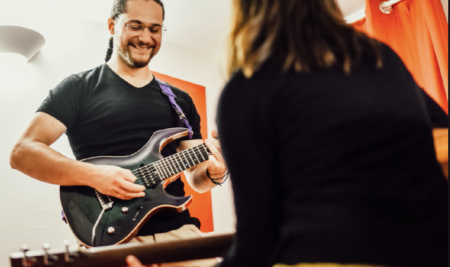
La Guitar Academy (Accademia di Chitarra Moderna), nasce nel 1996 grazie al chitarrista e didatta Andrea Quartarone che ne è attualmente Direttore Generale. Nei quasi 25 anni di attività didattica svolta (1996-2020), circa 1200 allievi hanno studiato sui nostri programmi e frequentato i nostri corsi di chitarra moderna.
La “mission” della Guitar Academy è offrire dei corsi di formazione a chiunque abbia un reale e vivo interesse per la chitarra e la musica, elemento essenziale che, unitamente all’efficacia del metodo utilizzato e alla professionalità degli insegnanti, garantisce un risultato reale, indipendentemente dall’età, dalla formazione musicale pregressa, o dal genere di musica ascoltato/suonato.
GuitarClub Magazine La rivista per gli appasionati di chitarre e musica
- GRETA VAN FLEET “Palace For The People”by info@guitarclubmagazine.com on 10 Ottobre 2026 at 16:44
I Greta Van Fleet pubblicano “Palace For The People”, accompagnandolo con il singolo “Tear It Down”.
- Eddie... ti inviamo tutta la nostra carica e tutto il nostro affetto di italiani!by info@guitarclubmagazine.com on 10 Ottobre 2026 at 16:44
Eddie – Eddie Van Halen – sta male. Le preoccupazioni sul suo stato di salute si rincorrono nel mondo mentre lui stesso dichiara: “E’ stato il plettro di metallo che solitamente tenevo in bocca la causa del mio tumore alla gola…” Amici, inviamo a Eddie tutta l'energia e l'affetto di noi
- PAUL WARREN A story to be toldby info@guitarclubmagazine.com on 10 Ottobre 2026 at 16:44
Ray Manzarek, Tina Turner, Joe Cocker, Rod Stewart, Parliament Funkadelic, i The Temptations… sono tutti accomunati da un nome: Paul Warren. Nel 1973, all’età di diciassette anni firma il suo primo contratto con la Motown, raggiungendo poco dopo il primo posto delle classifiche grazie alla sua.
gearnews.com The latest equipment news & rumors for guitar, recording and synthesizer.
- Squier Savings for Starters: Deals of the Week!by Jef on 10 Ottobre 2026 at 05:00
This week I show you my top Squier Deals at Thomann, with something for beginners and beyond! The post Squier Savings for Starters: Deals of the Week! appeared first on gearnews.com.
- Behringer Jam and Jam Play: Kick Out the Jams… And Play!by Adam Douglas on 9 Ottobre 2026 at 23:18
Meet the Behringer Jam and Jam Play, two portable controllers with some interesting extras up their sleeves. The post Behringer Jam and Jam Play: Kick Out the Jams… And Play! appeared first on gearnews.com.
- ATOV FaderPunk: Now Available at Thomannby Adam Douglas on 9 Ottobre 2026 at 21:39
ATOV FaderPunk is at last available from Thomann. It's never been easier to get your hands on the flexible modulation controller powerhouse. The post ATOV FaderPunk: Now Available at Thomann appeared first on gearnews.com.
Guitar.com | All Things Guitar The destination for all things guitar
- Get up to 20% off Fender this October at Guitar Center!by Rachel Roberts on 9 Ottobre 2026 at 16:14
Bag a bargain with an exclusive finish. The post Get up to 20% off Fender this October at Guitar Center! appeared first on Guitar.com | All Things Guitar.
- Are you better off building your own fuzz pedal?by Cillian Breathnach on 9 Ottobre 2026 at 14:18
Kits and ground-up fuzz builds are a little more involved than just grabbing a production pedal – but there’s some magic to be had in them. The post Are you better off building your own fuzz pedal? appeared first on Guitar.com | All Things Guitar.
- Are PRS Guitars priced so highly that only “dentists and doctors” can afford them? Paul Reed Smith responds: “We’ve done everything in our power to make the SEs affordable”by Rachel Roberts on 9 Ottobre 2026 at 13:10
“I didn’t know Carlos Santana and John Mayer were dentists...” The post Are PRS Guitars priced so highly that only “dentists and doctors” can afford them? Paul Reed Smith responds: “We’ve done everything in our power to make the SEs affordable” appeared first on Guitar.com | All Things Guitar.
Latest from Guitar Player All the latest content from the Guitar Player team
- Jim McCarty recalls Eric Clapton’s “quite unhappy” time with the Yardbirdsby Gary Graff on 9 Ottobre 2026 at 21:52
The Yardbirds drummer tells GP Clapton thought the group was selling out when it chose to record “For Your Love.” It turned out to be their first hit
- Metallica play “Fade to Black” at Las Vegas Sphere as they change up setlist for their third residency showby Elizabeth Swann on 9 Ottobre 2026 at 18:19
The Ride the Lightning classic was among the changes to the setlist, which also featured “Orion” in place of “The Call of Ktulu”
- Geordie Greep takes the stage to deny rape allegation at Vancouver show, saying “I’m not a rapist”by Christopher Scapelliti on 9 Ottobre 2026 at 15:29
The former Black Midi frontman addressed fliers accusing him of sexual assault, performed without his backing band and pledged the concert’s proceeds to an anti-violence organization.
Premier Guitar Premier Guitar
- Seward Park Electric Maravilla Reviewby Charles Saufley on 9 Ottobre 2026 at 14:00
Preamp pedals can be a lot of things. They tend to get lumped in with overdrives and boosts, and, in a sense, that’s fair. Preamps, ODs, and boosts are all plugged in before an amplifier’s power section, after all—usually employed to add body, grit, or a measure of distortion.So, what’s the difference? Well, in the absence of a definitive answer about clipping and EQ circuitry differences—and certainly these can be factors—it can be just as helpful to imagine the preamp/overdrive divide in terms of personalities. An overdrive can be charming but brusque—all full of easy answers to life’s problems and, sometimes, a bit of loudmouth. A good preamp, meanwhile, can be the life of the party—an extrovert even! But it can also be an empathetic, responsive listener and conversationalist.OK, maybe that isn’t the most watertight metaphor, but Seward Park Electric's Maravilla preamp is one pedal that makes it look particularly apt. Compared to many overdrives, the Maravilla has a huge tone vocabulary—one that spans civilized, sparkling, and venomous. It tends to feel exceptionally well integrated with your amp and guitar. And at the right settings, the Maravilla adds color and energy to a signal without hoovering up the oxygen that makes a guitar feel alive in your hands. Whatever you call it, it has more to offer as a tactile link to your guitar and as a tone scalpel than most overdrives I know.Maximized MultifactednessThe essence of what makes the Maravilla tick is not terribly complex. Gain is generated via germanium transistors, which are less common in overdrives but make the pedal more dynamically responsive and lend the drive a smoother, less aggro voice. But it’s how the Maravilla builds upon this simple architecture that makes a difference. There is no single drive control on the Maravilla. But a pre-gain control enables you to smash the germanium transistors with input gain, while the post-gain control enables you to take the output from the germanium transistor section and pound the transformer for even more saturation. Transformers are not unheard of in effects pedals, but they aren’t commonplace either. Functionally they can take the place of buffers. But here, as in other excellent preamp-inspired pedals like Hudson’s Broadcast, the Maravilla also uses a transformer to lend extra richness to the distortion.This simple, if slightly unorthodox, gain chain conjures many complex drive shades by itself. But the Maravilla’s powerful, fluid EQ section also transforms the distortion. The pedal even offers a post-gain presence control, called “air” here, that changes the gain and compression characteristics, along with how the pedal responds to touch and picking dynamics.“Just as with single coils, the germanium bits of the Maravilla’s beating heart are responsive to touch, tone, and volume dynamics in ways that expand the PAF vocabulary.”The Punch SpectrumUncovering Maravilla’s treasures can feel like fumbling in the dark at first—such are the interactive sensitivities of the six controls. Having all six knobs at noon positions is not a bad place to begin, and you can usually find a baseline not too far from your guitar and amp’s natural voice in these regions. But it pays to be bold as you venture forth from there. And getting a feel for how the post- and pre-gain controls shift the feel of your rig is an ideal launch pad for these experiments.Slightly advanced pre-gain levels tend to generate sounds and attack most like a conventional overdrive. And depending on where I set the pedal’s EQ, I find sounds similar to those from the Klon and Tube Screamer clones I use as overdrive reference. High post-gain settings in isolation introduce a lean, clean, muscular edge to an amplifier’s input. Any setting that favors heavy pre- or post-gain levels can yield creative results. But it’s when the two are used together in generous servings that the Maravilla comes alive.As organic amp-style drive goes, the sound and feel of both gain controls at 3 o’clock is hard to top. With a Telecaster and a Vibrolux on either side of the Maravilla, I heard a meaty, rambunctious version of this combination that suffers little from compression or unflattering midrange spikes. You can dial in plenty of compression and odd EQ peaks with the air and EQ controls if you want. But in terms of creating burly, blossoming, naturalistic variations on your natural guitar/amp voice, the two gain controls working together with smooth EQ combos yields the goods. Maximum pre- and post-gain settings sound fantastic too and made the Telecaster and Vibrolux sound positively Marshall-like. But any of these combinations of high pre- and post-gain distortion can be tamed and made near-clean with guitar volume attenuation, and I tended to keep them at higher levels for that reason.Humbuckers, predictably, have a different relationship with Maravilla. I found the sweetest drive sounds by favoring the pre-gain, using a less dynamic air setting and more conservative tone levels. But just as with single-coils, the germanium bits of the Maravilla’s beating heart are responsive to touch, tone, and volume dynamics in ways that expand the PAF vocabulary. The Maravilla dazzles with Vox- and Marshall-style amps too. It can make an EL84-based rig sound sizzly. But dialing back the pedal’s rangy treble control and adding a scoop of preamp gain can give the combination a buzzy ’60s-practice-amp-set-to-blast essence that, with a little guitar volume and tone attenuation, recalls the crunchy/fuzzy tones David Hidalgo and Tchad Blake cooked up for Latin Playboys’ records. If you’re strictly into the maximum rock ‘n’ roll potentialities of a British amp and the Maravilla, though, fear not. It’s just as easy to dial up monster sounds as it is to find off-kilter ones.The VerdictUsing the Maravailla in performance can be tricky business if you don’t do your homework. And paradoxically, this means its wonderful versatility may be its only drawback. But this is a drawback in very relative terms. The homework Maravilla demands of you is 101-level stuff. Yes, small adjustments to any of the Maravilla’s controls can profoundly affect the whole, and you might create something ghastly before you happen upon the magic recipe that matches your aims. But the Maravilla is forgiving, and you get used to the sweeps and range in its controls fast. It’s fantastic for awakening lifeless, one-dimensional signals that are missing energy or a certain EQ emphasis. It can add aggression through unique shades of saturation that can span smooth and fuzzy. And as you get to know its core strengths, you may find that some of the strangest sounds it produces might just become the most essential. Indeed, if the most obvious tone sweeteners here don’t convince you of Maravilla’s ability to outperform your average overdrive, the unexpected surprises most certainly will.
- Susan Tedeschi and Derek Trucks' "The Art of Music" Debuts October 1st on Public Televisionby News on 9 Ottobre 2026 at 13:39
- YouTubeOctober 1st marks the premiere of The Art of Music’s third episode, featuring GRAMMY © Award winning blues rock combo and Tedeschi Trucks Band co-founders, Susan Tedeschi and Derek Trucks filmed live from The Metropolitan Museum of Art’s Petrie Sculpture Court. It features intimate performances and a wide-ranging interview with legendary music journalist David Fricke. Corporate funding for the series is provided by Chase. The series is distributed by NETA.Presented by United MileagePlus Cards from Chase. * PREVIEW at youtube.com/watch “What a beautiful and unique setting for a concert and interview,” said Derek Trucks. “Sitting in a room full of masterpieces from all over the world was inspiring - watching Susan hold and play Mississippi John Hurt’s guitar is something I won’t forget.”The episode reveals details of the Tedeschi and Trucks musical journey, inspirations, family influences, and their personal connection to Derek and the Dominos’ “Bell Bottom Blues.” A performance with Sippie Wallace's “Women Be Wise” on Mississippi John Hurt's Gibson guitar, drawn from the Met's collection and a breakdown of “Who Am I” and “What in the World” highlight music from their sixth studio album release Future Soul. Check local listings for more information at listings.tracmedia.com/artOfMusic. “The Art of Music” format keeps pulling extraordinary moments like this out of artists,” said Don Maggi, founder and president of iMaggination. “Susan and Derek didn't just talk about their influences — they played them, on an instrument from the Met's own collection. That's what this series is built to do.”This special interview and performance featuring Susan Tedeschi and Derek Trucks presented by United MileagePlus Cards from Chase was an unforgettable occasion for Chase United Cardmembers who were invited to attend the intimate live taping. TheUnited MileagePlus Cards from Chase provide Cardmembers with access to exclusive events and experiences in addition to many reward and travel benefits with United Airlines. Other episodes of The Art of Music include Sheryl Crow with Jason Isbell and Peter Frampton with Warren Haynes, available at www.theartofmusic.co.
- Slash Honored with 2026 Les Paul Spirit Award During Hollywood Celebrationby News on 8 Ottobre 2026 at 20:56
Rock icon Slash received the 2026 Les Paul Spirit Award last night, Monday, October 5, during an intimate celebration at The Les Paul Recording Studio at Universal Master Recordings in Hollywood.Presented by the Les Paul Foundation in partnership with Gibson Gives, the philanthropic arm of Gibson, the private event brought together a room filled with music-industry luminaries, artists, media, friends and special guests to honor Slash’s extraordinary creative legacy, pioneering musicianship and enduring influence on generations of artists and fans. The evening centered on the presentation of the one-of-a-kind Les Paul Spirit Award, recognizing Slash as an artist who embodies Les Paul’s pioneering spirit through innovation, creativity, technology and music. The celebration also included a reception and a tour of the historic recording studio, offering guests a closer look at the remarkable legacy of Les Paul and the continuing impact of his work on modern music and recording. Slash and Les Paul shared a special friendship during Les Paul’s lifetime and often played music together. That personal connection brought added meaning to the evening as guests celebrated not only two of the most recognizable guitarists in music history, but also two artists united by an enduring curiosity, an instinct for innovation and a lifelong commitment to expanding the expressive possibilities of the electric guitar.“Les was so much more than a great guitarist and innovator. He was an actual inventor who changed the instrument itself, built groundbreaking recording equipment and completely reimagined how artists could record music. I feel incredibly lucky that I got to know him, hang out with him and play music with him. I cherish the relationship we had, and receiving an award that carries his name and spirit is a tremendous honor.” --Slash “We are honored to present the Les Paul Spirit Award to Slash this year. He and Les shared a special friendship and often jammed together when they could,” said Michael Braunstein, Executive Director of the Les Paul Foundation. “Not only does Slash exemplify the creativity and curiosity Les had during his life, but he is also an extraordinary talent and a wonderful supporter of the Les Paul Foundation. If Les were still alive today, Slash and he would be jamming onstage together somewhere regularly.” The annual Les Paul Spirit Award is presented to an individual who exemplifies the spirit of the late Les Paul through innovation, engineering, technology and music. The physical award presented to Slash was created from actual hand-carved acoustic boards that Les Paul built and used in his home recording studio. Because each award is fashioned from authentic studio materials personally created by Les Paul, no two Les Paul Spirit Awards are exactly alike.Previous recipients of the Les Paul Spirit Award include Bob Weir, Nile Rodgers, the Edge, Peter Frampton and Steve Miller. Slash now joins that distinguished group of artists whose creativity, originality and contributions to music reflect the trailblazing spirit that defined Les Paul’s life and career. A GRAMMY Award-winning guitarist, songwriter and Rock and Roll Hall of Fame inductee, Slash has helped define generations of rock music through his work with Guns N’ Roses, Velvet Revolver, Slash’s Snakepit, Slash Ft. Myles Kennedy & The Conspirators and Slash’s Blues Ball Band. With more than 100 million albums sold worldwide, he has created some of the most iconic guitar performances in rock history while continuing to push his artistry into new territory. His most recent solo album, Orgy of the Damned, was released by Gibson Records in 2024 and topped the Billboard Blues Albums chart for 13 weeks. Whether exploring the blues or recording rock albums with Slash FT. MYLES KENNEDY & THE CONSPIRATORS, Slash remains driven by the same instinctive, collaborative approach that has defined his career.Prior to the award presentation, select members of the media were invited inside the Les Paul Recording Studio for an exclusive advance listening session featuring four songs from Slash FT. MYLES KENNEDY & THE CONSPIRATORS’ forthcoming album, Flying Blind. Guests heard “Good Time Girl,” “One of Your Kind,” “Flying Blind” and “Looking for a Miracle,” offering an early glimpse at the band’s next creative chapter. Set for release on February 26, 2027, via Gibson Records, Flying Blind was recorded largely live with producer Michael “Elvis” Baskette and captures the raw chemistry and unfiltered energy that have become hallmarks of the band’s sound. The preview underscored that, even after decades at the forefront of rock music, Slash continues to create with the same passion, spontaneity and commitment to collaboration that have defined his extraordinary career. The Flying Blind WORLD TOUR 2027 will take Slash FT. MYLES KENNEDY & THE CONSPIRATORS across Latin America, North America, the United Kingdom and Europe, with stops at iconic venues including The Wiltern, Beacon Theatre and Ryman Auditorium. Tickets are on sale now: home.slashonline.com/tour.
- Harry Styles & Thom Yorke, calpestare le regoleby Claudio Todesco on 10 Ottobre 2026 at 10:21
Vi sembra strano vederli assieme? Sono più simili di quanto crediate. L’irrequietezza creativa, l’antinostalgia, la sindrome dell’impostore. Un incontro inatteso, un dialogo libero, un’amicizia iniziata per le strade di Roma The post Harry Styles & Thom Yorke, calpestare le regole first appeared on Rolling Stone Italia.
- Judas Priest, Ian Hill si ritira: «Quel momento è arrivato»by aimi on 10 Ottobre 2026 at 08:16
Dopo 56 anni il bassista lascia la band a causa dell'artrite e di un infortunio alla spalla, ma non solo: «Ho trascurato la mia famiglia per 57 anni». A sostituirlo nelle prossime date sarà Davey Rimmer degli Uriah Heep The post Judas Priest, Ian Hill si ritira: «Quel momento è arrivato» first appeared on Rolling Stone Italia.
- Ella Langley, concerto annullato per minacce di sparatorie ed esplosioniby aimi on 10 Ottobre 2026 at 07:39
L’allarme è scattato dopo una telefonata che annunciava un possibile attacco al BOK Center di Tulsa. Due controlli della polizia non hanno trovato minacce concrete, ma lo show è stato annullato. Indaga anche l’FBI The post Ella Langley, concerto annullato per minacce di sparatorie ed esplosioni first appeared on Rolling Stone Italia.
Premier Guitar Premier Guitar
- Seward Park Electric Maravilla Reviewby Charles Saufley on 9 Ottobre 2026 at 14:00
Preamp pedals can be a lot of things. They tend to get lumped in with overdrives and boosts, and, in a sense, that’s fair. Preamps, ODs, and boosts are all plugged in before an amplifier’s power section, after all—usually employed to add body, grit, or a measure of distortion.So, what’s the difference? Well, in the absence of a definitive answer about clipping and EQ circuitry differences—and certainly these can be factors—it can be just as helpful to imagine the preamp/overdrive divide in terms of personalities. An overdrive can be charming but brusque—all full of easy answers to life’s problems and, sometimes, a bit of loudmouth. A good preamp, meanwhile, can be the life of the party—an extrovert even! But it can also be an empathetic, responsive listener and conversationalist.OK, maybe that isn’t the most watertight metaphor, but Seward Park Electric's Maravilla preamp is one pedal that makes it look particularly apt. Compared to many overdrives, the Maravilla has a huge tone vocabulary—one that spans civilized, sparkling, and venomous. It tends to feel exceptionally well integrated with your amp and guitar. And at the right settings, the Maravilla adds color and energy to a signal without hoovering up the oxygen that makes a guitar feel alive in your hands. Whatever you call it, it has more to offer as a tactile link to your guitar and as a tone scalpel than most overdrives I know.Maximized MultifactednessThe essence of what makes the Maravilla tick is not terribly complex. Gain is generated via germanium transistors, which are less common in overdrives but make the pedal more dynamically responsive and lend the drive a smoother, less aggro voice. But it’s how the Maravilla builds upon this simple architecture that makes a difference. There is no single drive control on the Maravilla. But a pre-gain control enables you to smash the germanium transistors with input gain, while the post-gain control enables you to take the output from the germanium transistor section and pound the transformer for even more saturation. Transformers are not unheard of in effects pedals, but they aren’t commonplace either. Functionally they can take the place of buffers. But here, as in other excellent preamp-inspired pedals like Hudson’s Broadcast, the Maravilla also uses a transformer to lend extra richness to the distortion.This simple, if slightly unorthodox, gain chain conjures many complex drive shades by itself. But the Maravilla’s powerful, fluid EQ section also transforms the distortion. The pedal even offers a post-gain presence control, called “air” here, that changes the gain and compression characteristics, along with how the pedal responds to touch and picking dynamics.“Just as with single coils, the germanium bits of the Maravilla’s beating heart are responsive to touch, tone, and volume dynamics in ways that expand the PAF vocabulary.”The Punch SpectrumUncovering Maravilla’s treasures can feel like fumbling in the dark at first—such are the interactive sensitivities of the six controls. Having all six knobs at noon positions is not a bad place to begin, and you can usually find a baseline not too far from your guitar and amp’s natural voice in these regions. But it pays to be bold as you venture forth from there. And getting a feel for how the post- and pre-gain controls shift the feel of your rig is an ideal launch pad for these experiments.Slightly advanced pre-gain levels tend to generate sounds and attack most like a conventional overdrive. And depending on where I set the pedal’s EQ, I find sounds similar to those from the Klon and Tube Screamer clones I use as overdrive reference. High post-gain settings in isolation introduce a lean, clean, muscular edge to an amplifier’s input. Any setting that favors heavy pre- or post-gain levels can yield creative results. But it’s when the two are used together in generous servings that the Maravilla comes alive.As organic amp-style drive goes, the sound and feel of both gain controls at 3 o’clock is hard to top. With a Telecaster and a Vibrolux on either side of the Maravilla, I heard a meaty, rambunctious version of this combination that suffers little from compression or unflattering midrange spikes. You can dial in plenty of compression and odd EQ peaks with the air and EQ controls if you want. But in terms of creating burly, blossoming, naturalistic variations on your natural guitar/amp voice, the two gain controls working together with smooth EQ combos yields the goods. Maximum pre- and post-gain settings sound fantastic too and made the Telecaster and Vibrolux sound positively Marshall-like. But any of these combinations of high pre- and post-gain distortion can be tamed and made near-clean with guitar volume attenuation, and I tended to keep them at higher levels for that reason.Humbuckers, predictably, have a different relationship with Maravilla. I found the sweetest drive sounds by favoring the pre-gain, using a less dynamic air setting and more conservative tone levels. But just as with single-coils, the germanium bits of the Maravilla’s beating heart are responsive to touch, tone, and volume dynamics in ways that expand the PAF vocabulary. The Maravilla dazzles with Vox- and Marshall-style amps too. It can make an EL84-based rig sound sizzly. But dialing back the pedal’s rangy treble control and adding a scoop of preamp gain can give the combination a buzzy ’60s-practice-amp-set-to-blast essence that, with a little guitar volume and tone attenuation, recalls the crunchy/fuzzy tones David Hidalgo and Tchad Blake cooked up for Latin Playboys’ records. If you’re strictly into the maximum rock ‘n’ roll potentialities of a British amp and the Maravilla, though, fear not. It’s just as easy to dial up monster sounds as it is to find off-kilter ones.The VerdictUsing the Maravailla in performance can be tricky business if you don’t do your homework. And paradoxically, this means its wonderful versatility may be its only drawback. But this is a drawback in very relative terms. The homework Maravilla demands of you is 101-level stuff. Yes, small adjustments to any of the Maravilla’s controls can profoundly affect the whole, and you might create something ghastly before you happen upon the magic recipe that matches your aims. But the Maravilla is forgiving, and you get used to the sweeps and range in its controls fast. It’s fantastic for awakening lifeless, one-dimensional signals that are missing energy or a certain EQ emphasis. It can add aggression through unique shades of saturation that can span smooth and fuzzy. And as you get to know its core strengths, you may find that some of the strangest sounds it produces might just become the most essential. Indeed, if the most obvious tone sweeteners here don’t convince you of Maravilla’s ability to outperform your average overdrive, the unexpected surprises most certainly will.
- Susan Tedeschi and Derek Trucks' "The Art of Music" Debuts October 1st on Public Televisionby News on 9 Ottobre 2026 at 13:39
- YouTubeOctober 1st marks the premiere of The Art of Music’s third episode, featuring GRAMMY © Award winning blues rock combo and Tedeschi Trucks Band co-founders, Susan Tedeschi and Derek Trucks filmed live from The Metropolitan Museum of Art’s Petrie Sculpture Court. It features intimate performances and a wide-ranging interview with legendary music journalist David Fricke. Corporate funding for the series is provided by Chase. The series is distributed by NETA.Presented by United MileagePlus Cards from Chase. * PREVIEW at youtube.com/watch “What a beautiful and unique setting for a concert and interview,” said Derek Trucks. “Sitting in a room full of masterpieces from all over the world was inspiring - watching Susan hold and play Mississippi John Hurt’s guitar is something I won’t forget.”The episode reveals details of the Tedeschi and Trucks musical journey, inspirations, family influences, and their personal connection to Derek and the Dominos’ “Bell Bottom Blues.” A performance with Sippie Wallace's “Women Be Wise” on Mississippi John Hurt's Gibson guitar, drawn from the Met's collection and a breakdown of “Who Am I” and “What in the World” highlight music from their sixth studio album release Future Soul. Check local listings for more information at listings.tracmedia.com/artOfMusic. “The Art of Music” format keeps pulling extraordinary moments like this out of artists,” said Don Maggi, founder and president of iMaggination. “Susan and Derek didn't just talk about their influences — they played them, on an instrument from the Met's own collection. That's what this series is built to do.”This special interview and performance featuring Susan Tedeschi and Derek Trucks presented by United MileagePlus Cards from Chase was an unforgettable occasion for Chase United Cardmembers who were invited to attend the intimate live taping. TheUnited MileagePlus Cards from Chase provide Cardmembers with access to exclusive events and experiences in addition to many reward and travel benefits with United Airlines. Other episodes of The Art of Music include Sheryl Crow with Jason Isbell and Peter Frampton with Warren Haynes, available at www.theartofmusic.co.
- Slash Honored with 2026 Les Paul Spirit Award During Hollywood Celebrationby News on 8 Ottobre 2026 at 20:56
Rock icon Slash received the 2026 Les Paul Spirit Award last night, Monday, October 5, during an intimate celebration at The Les Paul Recording Studio at Universal Master Recordings in Hollywood.Presented by the Les Paul Foundation in partnership with Gibson Gives, the philanthropic arm of Gibson, the private event brought together a room filled with music-industry luminaries, artists, media, friends and special guests to honor Slash’s extraordinary creative legacy, pioneering musicianship and enduring influence on generations of artists and fans. The evening centered on the presentation of the one-of-a-kind Les Paul Spirit Award, recognizing Slash as an artist who embodies Les Paul’s pioneering spirit through innovation, creativity, technology and music. The celebration also included a reception and a tour of the historic recording studio, offering guests a closer look at the remarkable legacy of Les Paul and the continuing impact of his work on modern music and recording. Slash and Les Paul shared a special friendship during Les Paul’s lifetime and often played music together. That personal connection brought added meaning to the evening as guests celebrated not only two of the most recognizable guitarists in music history, but also two artists united by an enduring curiosity, an instinct for innovation and a lifelong commitment to expanding the expressive possibilities of the electric guitar.“Les was so much more than a great guitarist and innovator. He was an actual inventor who changed the instrument itself, built groundbreaking recording equipment and completely reimagined how artists could record music. I feel incredibly lucky that I got to know him, hang out with him and play music with him. I cherish the relationship we had, and receiving an award that carries his name and spirit is a tremendous honor.” --Slash “We are honored to present the Les Paul Spirit Award to Slash this year. He and Les shared a special friendship and often jammed together when they could,” said Michael Braunstein, Executive Director of the Les Paul Foundation. “Not only does Slash exemplify the creativity and curiosity Les had during his life, but he is also an extraordinary talent and a wonderful supporter of the Les Paul Foundation. If Les were still alive today, Slash and he would be jamming onstage together somewhere regularly.” The annual Les Paul Spirit Award is presented to an individual who exemplifies the spirit of the late Les Paul through innovation, engineering, technology and music. The physical award presented to Slash was created from actual hand-carved acoustic boards that Les Paul built and used in his home recording studio. Because each award is fashioned from authentic studio materials personally created by Les Paul, no two Les Paul Spirit Awards are exactly alike.Previous recipients of the Les Paul Spirit Award include Bob Weir, Nile Rodgers, the Edge, Peter Frampton and Steve Miller. Slash now joins that distinguished group of artists whose creativity, originality and contributions to music reflect the trailblazing spirit that defined Les Paul’s life and career. A GRAMMY Award-winning guitarist, songwriter and Rock and Roll Hall of Fame inductee, Slash has helped define generations of rock music through his work with Guns N’ Roses, Velvet Revolver, Slash’s Snakepit, Slash Ft. Myles Kennedy & The Conspirators and Slash’s Blues Ball Band. With more than 100 million albums sold worldwide, he has created some of the most iconic guitar performances in rock history while continuing to push his artistry into new territory. His most recent solo album, Orgy of the Damned, was released by Gibson Records in 2024 and topped the Billboard Blues Albums chart for 13 weeks. Whether exploring the blues or recording rock albums with Slash FT. MYLES KENNEDY & THE CONSPIRATORS, Slash remains driven by the same instinctive, collaborative approach that has defined his career.Prior to the award presentation, select members of the media were invited inside the Les Paul Recording Studio for an exclusive advance listening session featuring four songs from Slash FT. MYLES KENNEDY & THE CONSPIRATORS’ forthcoming album, Flying Blind. Guests heard “Good Time Girl,” “One of Your Kind,” “Flying Blind” and “Looking for a Miracle,” offering an early glimpse at the band’s next creative chapter. Set for release on February 26, 2027, via Gibson Records, Flying Blind was recorded largely live with producer Michael “Elvis” Baskette and captures the raw chemistry and unfiltered energy that have become hallmarks of the band’s sound. The preview underscored that, even after decades at the forefront of rock music, Slash continues to create with the same passion, spontaneity and commitment to collaboration that have defined his extraordinary career. The Flying Blind WORLD TOUR 2027 will take Slash FT. MYLES KENNEDY & THE CONSPIRATORS across Latin America, North America, the United Kingdom and Europe, with stops at iconic venues including The Wiltern, Beacon Theatre and Ryman Auditorium. Tickets are on sale now: home.slashonline.com/tour.
Acoustic Guitar lessons, music to play, and how-tos for all guitarists
- Learn Laura Snowden’s Melody-Driven Arrangement of the Traditional Irish Folk Song “Carrickfergus”by Laura Snowden on 7 Ottobre 2026 at 13:00
This arrangement for classical guitar is all about resonance and letting the melody sing.
- How to Play “Heart of Gold,” Neil Young’s Simple but Enduring Hitby Adam Perlmutter on 30 Settembre 2026 at 13:00
Harmonically, the song, which is in the key of E minor, is very simple. It’s built from five chords—in order of appearance, Em7, D, Em, C, and G.
- Letter from the Editor | Acoustic Guitar, Fall 2026 Issue 359by Adam Perlmutter on 25 Settembre 2026 at 13:00
Whether it's Isa Burke's interview with Courtney Hartman, the luthier roundtable, or the transcription of Paul McCartney’s "Days We Left Behind," I hope enjoy spending time with this issue and find something in it that makes its way into your own music.

28 Marzo 2020
Livending 2020
28 Marzo 2020
La nuova sede di Siracusa
28 Marzo 2020
Nuova sessione d’esami a Giugno/Luglio 2020

28 Marzo 2020
Nuovo sito Guitar Academy